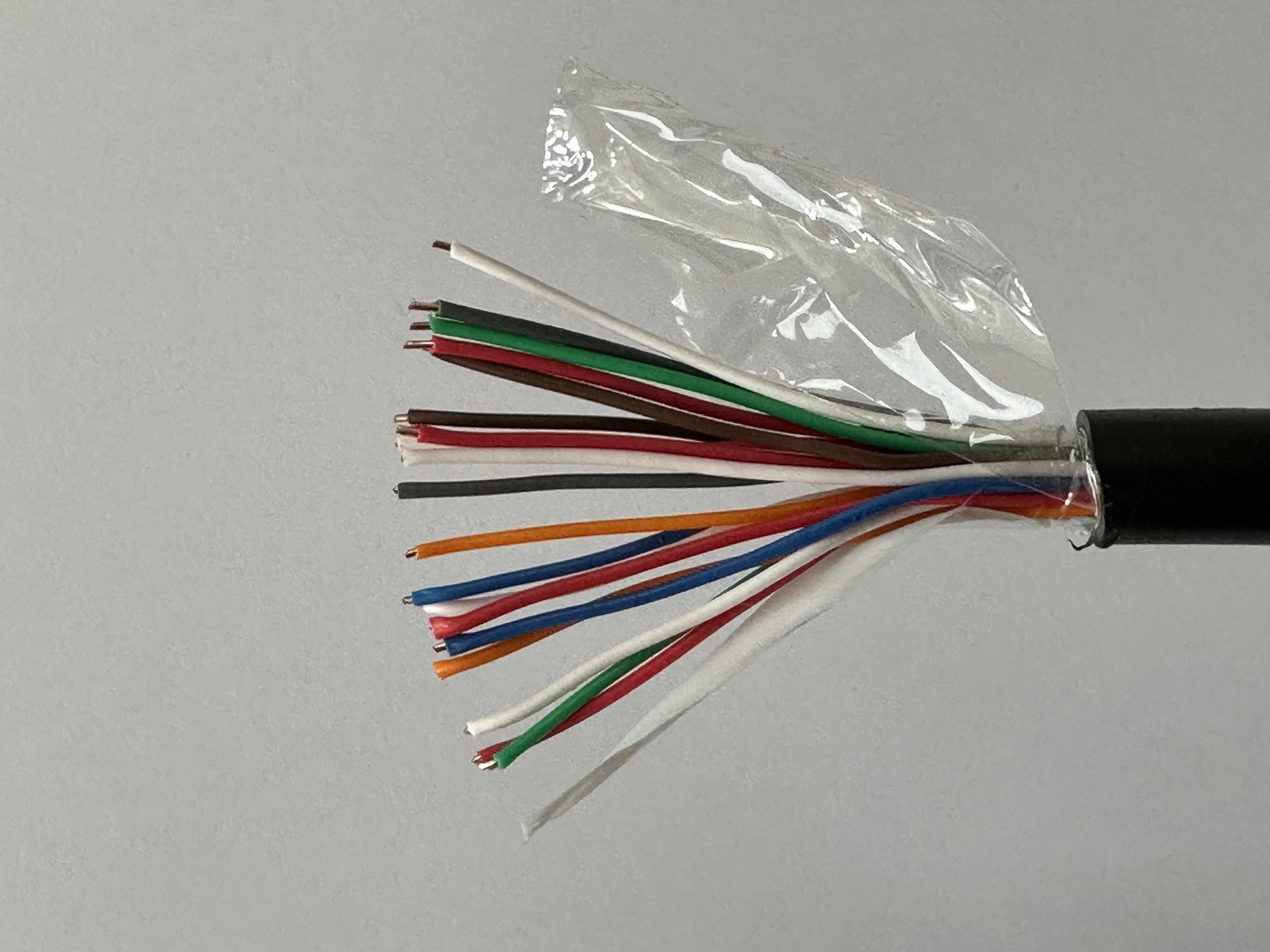
Fiber Optic Cable Multi Cord
Fiber optic cable or optical fiber is a flexible, transparent fiber
Certification Standards
Implementation Standards
- IEC 60793
- ITU G651.1
- ITU G652-G657
Product Introduction
Fiber optic cable or optical fiber is a flexible, transparent fiber. It is made of glass (silica) or plastic stretched to a diameter slightly thicker than the diameter of a human hair.
Optical fibers are most often used as a means of transmitting signals between the two ends of an optical fiber.
Multi core fiber optic cable is the presence of multiple cores in a common cladding area. Due to the proximity of the cores to each other, two functions are possible.
What is Multicore Fiber?
Let's start with the structure of a common single-core fiber.
The cross-section of a normal single-core fiber is composed of a core, a cladding, and a coating layer from the inside to the outside, cladding and coating layer.
The core and cladding are made of glass with different refractive indices, and the cladding is an elastic coating that is cured with UV light to protect the fiber while it is being pulled from the preform.
The diameter of ordinary hair is about 60um to 90um, and although the cladding diameter of a single-core fiber power cable is similar to that of ordinary hair, it is still too large relative to the diameter of the mode field.
So there is the production method of putting more fiber cores in the cladding, for example, 7 cores in the cladding.
One is a structure with large core spacing, i.e., no optical coupling. This type of fiber is due to the ability to increase the integrated density per unit area of the transmission line.
In multicore fiber optic communication, it can be made into a ribbon cable with multiple cores, and in the non-communication field, as a fiber optic transmission bundle, there are made into thousands of cores.
The second is to make the distance between the cores close to each other, which can produce a light-wave coupling effect. This principle is being used to develop a dual-core sensitive or optical circuit device.
GYTS Outdoor Armored Fiber Optic Cable
Standard: IEC 60793; ITU G651.1; ITU G652-G657
Type: single mode/multiple modes
Multi-Core: 2-144 fibers
Loose Tube: FRP
Central strength member: FRP
Filling: Jelly compound
Wrapping: water-blocking tape
Sheath: PE
Applications
A Fiber Optic Cable or multicore fiber cable is a flexible, transparent fiber made by drawing glass (silica) or plastic to a diameter slightly thicker than that of a human hair.
The flexible optical cable is used most often as a means to transmit light between the two ends of the fiber and finds wide usage in fiber-optic communications, where they permit transmission over longer distances and at higher bandwidths(data rates) than wire cables.
Fibers are used instead of metal wires because signals travel along them with less loss; in addition, fibers are immune to electromagnetic interference, a problem from which metal wires suffer excessively.
Fibers are also used for illumination and imaging and are often wrapped in bundles so that they may be used to carry light into, or images out of confined spaces, as in the case of a fiberscope.
Specially designed fibers are also used for a variety of other applications, some of them being fiber optic sensors and fiber lasers.
SiTong Cable Power Cable Manufacturer provides you with the best fiber optic cable solution.
Powered Fiber optic cords use Gigabit Ethernet, active device termination, telecommunication networks, video, multimedia, premise installations, local area networks, FTTH FTTX applications, and CATV.
Other Types of Fiber Optic Cable Multi Cord:
- ADSS Fiber Optic Cable (All-Dielectric Self-Supporting Cable)
- OPGW Fiber Optic (Optical Power Ground Wire) (Optical Ground Wire)
Technical Specifications
Fiber Optic Cable Specifications
| Fiber Count | 2-36 | 38-60 | 62-72 | 74-96 | 98-120 | 122-144 | 146-216 |
|---|---|---|---|---|---|---|---|
| Nominal Diameter (mm) | 12.8 | 14 | 14.7 | 16.1 | 17.6 | 19.1 | 19.3 |
| Nominal Weight (kg/km) | 187 | 208 | 220 | 260 | 293 | 356 | 375 |
| Permitted Tensile LT/ST (N) | 600/1500 (1000/3000) | 1000/3000 | 1000/3000 | 1000/3000 | 1000/3000 | 1000/3000 | 1000/3000 |
| Permitted Crush LC/SC (N) | 300/1000 (1000/3000) | 1000/3000 | 1000/3000 | 1000/3000 | 1000/3000 | 1000/3000 | 1000/3000 |
| Bend Radius Static/Dynamic (mm) | 12.5D/25D | 12.5D/25D | 12.5D/25D | 12.5D/25D | 12.5D/25D | 12.5D/25D | 12.5D/25D |
Application Fields
Fiber-optic communications
Telecommunication networks
Video and multimedia transmission
Premise installations
Local area networks
FTTH FTTX applications
CATV
Fiber optic sensors
Fiber lasers
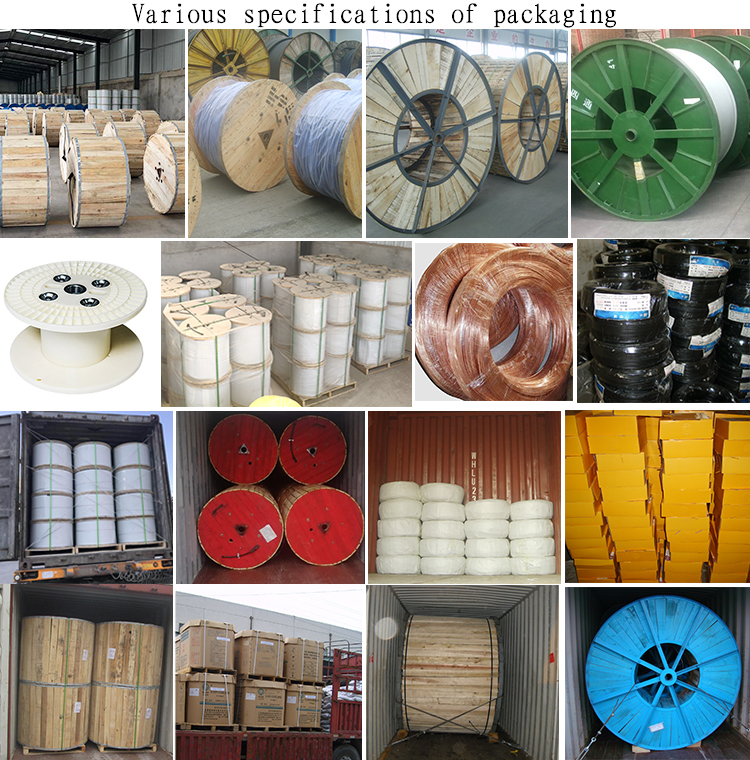
Packaging & Shipping
All cables will be packaged in different materials based on their outer diameter and net weight, and can be customized according to requirements